 Ask a question!


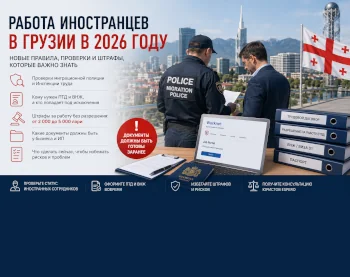
In 2026, the system for monitoring the employment of foreign nationals in Georgia shifted from a “formal framework” to practical implementation. Companies, sole proprietors, and foreign employees are increasingly facing inspections by immigration authorities, and issues related to work permits (PTD) and D1 visas have become a key concern for businesses.
This is particularly noticeable in Batumi, where foreign business has traditionally been very active.
According to observations by ESPERO, inspections by the Georgian Ministry of Internal Affairs’ migration police and agencies involved in labor migration control have become more frequent in recent months.
The main takeaway for businesses is simple: documents must be prepared in advance, and the status of each foreign national must be clear and verified.
What kinds of inspections are conducted in Georgia
During an inspection, officers from the Ministry of Internal Affairs or other authorized agencies typically:
present their official identification;
record the process on camera;
check the documents of employees and individuals present at the facility;
verify the grounds for their stay and employment in Georgia.
In practice, most inspections proceed correctly and calmly; however, a lack of documents can lead to serious consequences.
What foreigners are checked for
1. Legality of stay in Georgia
First and foremost, the foreigner’s immigration status is checked:
- Residence permit;
- D1 visa;
- Duration of visa‐free stay;
- Date of last entry into the country.
If a person is in Georgia under the visa‐free regime, inspectors may separately verify the duration of stay.
2. Right to work
The second key part of the check is the presence of a legal right to work in Georgia.
Depending on the situation, the following may be checked:
- work permit;
- registration on the Ministry of Labor portal;
- employment contract;
- internship agreement;
- self‐employed status;
- relationships with clients and employers.
Who will need a work permit in Georgia in 2026
Following the labor migration reform, the rules have become significantly stricter.
Employed workers
If a foreign employee works in Georgia under an employment contract, they are generally required to have:
- a work permit;
- a residence permit or a D1 work visa.
This applies especially to employees hired after March 2026.
Foreign sole proprietors and self‐employed individuals
One of the most controversial and sensitive issues is the work of sole proprietors and freelancers.
The general principle now is as follows:
A PTD is usually NOT required if:
- The individual entrepreneur provides services to foreign clients;
- the client’s activities are not related to Georgia;
- income is received from non‐residents.
A work permit may be required if:
- the client is a resident of Georgia;
- the activities are actually carried out for the Georgian market;
- the work is conducted from Georgia and generates economic benefits within the country.
Directors of Georgian companies
For directors and members of management bodies, the rules depend on the company’s category.
In some cases, directors may work without a work permit; however, for certain categories of companies, a work permit and a D1/residence permit are mandatory.
What fines apply in 2026
Fines for working without a work permit
For self‐employed foreigners, the base fine is:
- 2,000 lari — first offense;
- double the fine — repeat offense;
- further increase in penalties — for systematic violations.
However, paying the fine does not legalize further employment.
Separate fines for refusing to cooperate with inspectors
If a foreigner:
- fails to provide documents;
- obstructs the inspection;
- ignores the inspectors’ requests,
the fine can reach 5,000 lari.
Therefore, the strategy of “not showing documents” usually only makes the situation worse.
Which authorities are authorized to conduct inspections
Several agencies are responsible for monitoring labor migration in Georgia.
Labor inspectorate
The primary authority responsible for enforcing labor migration laws.
Georgian Ministry of internal affairs
The Migration Police also has the authority to:
- inspect foreign nationals;
- compile case files;
- identify violations of migration regulations.
Employment promotion agency
It does not typically issue fines on its own, but may forward information to other authorities.
What businesses need to have on hand during an inspection
Experience shows that the best approach is to prepare the necessary documents for each foreign national in advance.
The minimum set of documents usually includes:
- an employment contract or other document explaining the person’s status;
- a work permit (if required);
- a residence permit or confirmation of application for a residence permit;
- a copy of the passport;
- confirmation of registration on the Ministry of Labor portal;
- documents regarding the basis for stay.
Why it is important to properly register a foreign national’s status
During an inspection, the inspector should never have to ask, “Who is this person, and on what grounds are they here?”
This applies in particular to:
- interns;
- contractors;
- freelancers;
- sole proprietors;
- remote employees;
- business partners.
If a person’s status is unclear or documents are missing, this may serve as grounds for further inspection.
What you should do now
For businesses
- Review the documents of all foreign employees;
- determine who requires a temporary residence permit;
- prepare separate files for each foreign employee;
- verify the duration of employees’ stays;
- prepare staff for inspections.
For sole proprietors and freelancers
- Determine whether you qualify for any exemptions;
- keep contracts, invoices, and payment confirmations;
- have proof that your clients are non‐residents;
- resolve issues related to work permits and residence permits in advance.
Why the issue of work permits has become particularly important
Previously, many foreigners worked in Georgia effectively in a “gray area” — this was especially true for:
- self‐employed individuals;
- remote professionals;
- IT freelancers;
- consultants.
Now, the government is gradually transitioning the system to a format of full‐fledged immigration and labor control.
This means:
- more inspections;
- greater data sharing between agencies;
- greater attention to the foreigner’s actual place of work.
Frequently asked questions
Does a foreign sole proprietor in Georgia need a work permit?
It depends on who the services are provided to and whether the business is connected to the Georgian market.
Can you work in Georgia under the visa‐free regime?
The visa‐free regime does not always grant the right to work. In many cases, a work permit and a residence permit/D1 visa are also required.
What is the fine for working without a permit?
The base fine for a self‐employed foreigner is 2,000 lari.
Can the Ministry of Internal Affairs inspect a foreign business?
Yes. The Migration Police of the Georgian Ministry of Internal Affairs has the appropriate authority.
Is a residence permit required after obtaining a work permit?
In many cases — yes. To work legally, the following documents are usually required:
- work permit;
- residence permit or D1 visa.
Is it possible to obtain a residence permit without a work permit?
For employment purposes — generally, no.
What do they check during raids?
Usually:
- foreigners’ documents;
- right of residence;
- right to work;
- status of employees and contractors;
- availability of a work permit and registration on the Ministry of Labor portal.
Need help with work permits, residence permits, or risk assessments?
ESPERO Group assists foreigners and businesses in Georgia with:
- obtaining work permits;
- obtaining residence permits or D1 visas;
- conducting risk assessments for sole proprietors and the self‐employed;
- prepare documents for inspections;
- organize the work of foreign staff;
- facilitate interactions with government agencies.
We analyze each situation individually, taking into account:
- the type of business activity;
- the company category;
- tax status;
- the structure of clients and contracts.