 Ask a question!


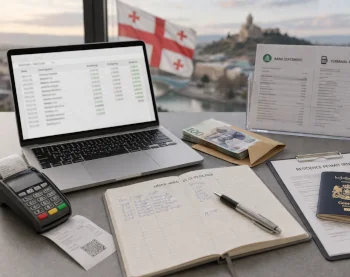
For entrepreneurs in Georgia operating under the fixed‐tax regime, the issue of proving income for a residence permit is the most contentious. The reason is clear: for such sole proprietors, accounting and tax logic differ from the standard small business model, which means the set of supporting documents looks different as well.
Let’s break down what income verification typically entails, which documents are truly important, and where problems most often arise.
What sets fixed‐tax sole proprietors apart
A fixed‐tax sole proprietor may apply for a work residence permit if they can verify the required turnover for the past 12 months. For this category of entrepreneurs, the key threshold in practice remains a turnover of 50,000 lari, and a work residence permit is issued to a foreigner who has obtained the right to engage in employment; the law also requires confirmation of entrepreneurial or employment activity in Georgia and compliance with established financial criteria.
The problem is that a fixed-tax payer does not always have the usual set of documents expected in other cases: for example, the standard logic based on tax reporting does not work as straightforwardly here as it does for sole proprietors in small businesses. Therefore, verification relies primarily on documents showing actual cash flow.
What exactly needs to be proven
For the purposes of obtaining a residence permit, it is not only the registration of the individual entrepreneur that matters, but also the fact that the entrepreneur actually conducted business and generated income from it. In other words, you need to demonstrate not just “paper status,” but documented revenue.
In practice, for sole proprietors on a fixed tax basis, proof of income is typically based on three sources:
- direct transfers from clients to a bank account;
- payments made via a terminal;
- cash receipts that are subsequently deposited into a bank account.
It is precisely this combination of documents that allows you to demonstrate that the required turnover did not arise merely on paper but is linked to actual business activity.
The main document — the bank statement
When it comes to the strongest evidence, it is usually the bank statement.
Why it is so important:
- it shows actual cash inflows;
- it shows the dates, amounts, and frequency of transactions;
- it is easier to accept as an objective document than the entrepreneur’s internal explanations.
If a client transferred payment directly to the sole proprietor’s account, these receipts usually serve as the basis for confirming turnover. The clearer the purpose of the payments and the more logical the pattern of receipts, the better.
If payment was made via a terminal
The second key area is revenue received via a terminal. Such amounts are typically verified by documents that can be obtained through the tax system or other official acquiring records.
This is particularly important for businesses where customers pay on‐site with a card rather than via bank transfer. In such cases, a single bank statement may not be sufficient to understand the source of the funds, making the terminal transaction history a crucial supplement.
Simply put, the logic here is as follows: if part of the revenue came not from bank transfers from customers but through a POS terminal, it is advisable to show both sides of the picture simultaneously — both the bank deposit and confirmation that these amounts came specifically from payment for services.
Can cash transactions be used to verify revenue?
Yes, in practice, a portion of revenue may be generated through cash transactions if the nature of the business allows for it. The material you provided describes a standard approach in which cash received from customers is subsequently deposited by the business owner into their own bank account with a clear payment description for a specific period.
But there is an important caveat here.
A cash deposit into an account does not, in and of itself, automatically prove that it is revenue from business activities. Therefore, the more “traces” such a sum leaves, the better:
- the period for which the money was deposited must be clear;
- the amounts must appear realistic for the type of business;
- it is desirable that the overall profile of transactions not appear artificial;
- the explanation of the funds’ origin must be logical and consistent.
In other words, cash inflows can contribute to the required turnover, but this is the most sensitive area from an audit perspective.
How verifiable turnover typically accumulates
In a practical scenario, turnover of 50,000 lari can be generated through several channels at once:
- part of the money came from customer transfers;
- part was paid via a terminal;
- part was received in cash and later deposited into the account.
Ultimately, for a residence permit, the authorities do not look at a single “perfect” document, but rather at the overall body of evidence. The clearer it is, the higher the chances that the inspector will not get the impression of an artificially created turnover.
Why the mere fact that money has been received is sometimes not enough
One of the main mistakes is to assume that if 50,000 lari has been deposited into an account, that is sufficient. In practice, evaluators consider not only the amount but also how it was generated.
Situations usually raise suspicion when:
- the required turnover was generated too quickly;
- the funds were received in large lump sums without a clear business rationale;
- there is no regularity;
- the business activity appears modest on paper, while the turnover is sharply inflated;
- the origin of the funds is poorly explained.
The relevant legal provision establishes the financial threshold for a work residence permit, but the law does not specify in detail which specific banking or cash transactions will be considered sufficiently convincing in each individual case; this is a matter of administrative practice and the evaluation of the submitted documents.
Therefore, it is not only the amount that matters, but also the quality of the evidence.
What to consider in advance
The best approach is to lay the groundwork for a residence permit well in advance, rather than at the last minute. In practice, this means following a few simple rules.
First, it is preferable for your income to come from a clear business model rather than from random sources.
Second, you should think in advance about what documents you will be able to provide for each type of income.
Third, if part of your income comes in cash, it’s best to establish an internal logic right away so that you can later easily explain the origin of each significant amount.
Finally, if revenue is growing very quickly, you need to be prepared for additional questions. Formally, rapid growth is not prohibited in itself, but it is precisely these cases that are more often perceived as risky.
What documents should you typically gather?
In practice, it’s wise to prepare a package consisting not of a single document, but of several complementary ones:
- bank account statements;
- proof of terminal transactions;
- if necessary — an explanation of cash deposits;
- documents confirming the sole proprietor’s business activities;
- if available — contracts, service confirmation documents, and other evidence of business activity.
Even if you are formally asked only for proof of income, a complete and coherent set of documents always works better than a single statement without context.
Conclusion
For sole proprietors on a fixed tax regime, proving income for a residence permit is based primarily not on the traditional tax return model, but on evidence of actual turnover. This is typically supported by bank statements, POS terminal records, and, if necessary, a verifiable rationale for cash receipts.
The main task is not simply to show the figure of 50,000 lari, but to convincingly explain where this figure came from and why it corresponds to your actual business activities.
This is precisely why, in such cases, it is not only the amounts that matter, but also consistency, transparency, and meticulous preparation of documents.
Need help with applying for a residence permit in Georgia?
ESPERO can help you:
- prepare the correct set of documents for a residence permit;
- properly verify your income (bank statements, POS terminal records, cash);
- assess risks and avoid rejection;
- guide you through the entire residence permit application process;
We have practical experience and know which documents are actually accepted.
Contact us — and we’ll help you obtain a residence permit without unnecessary risks or wasted time.